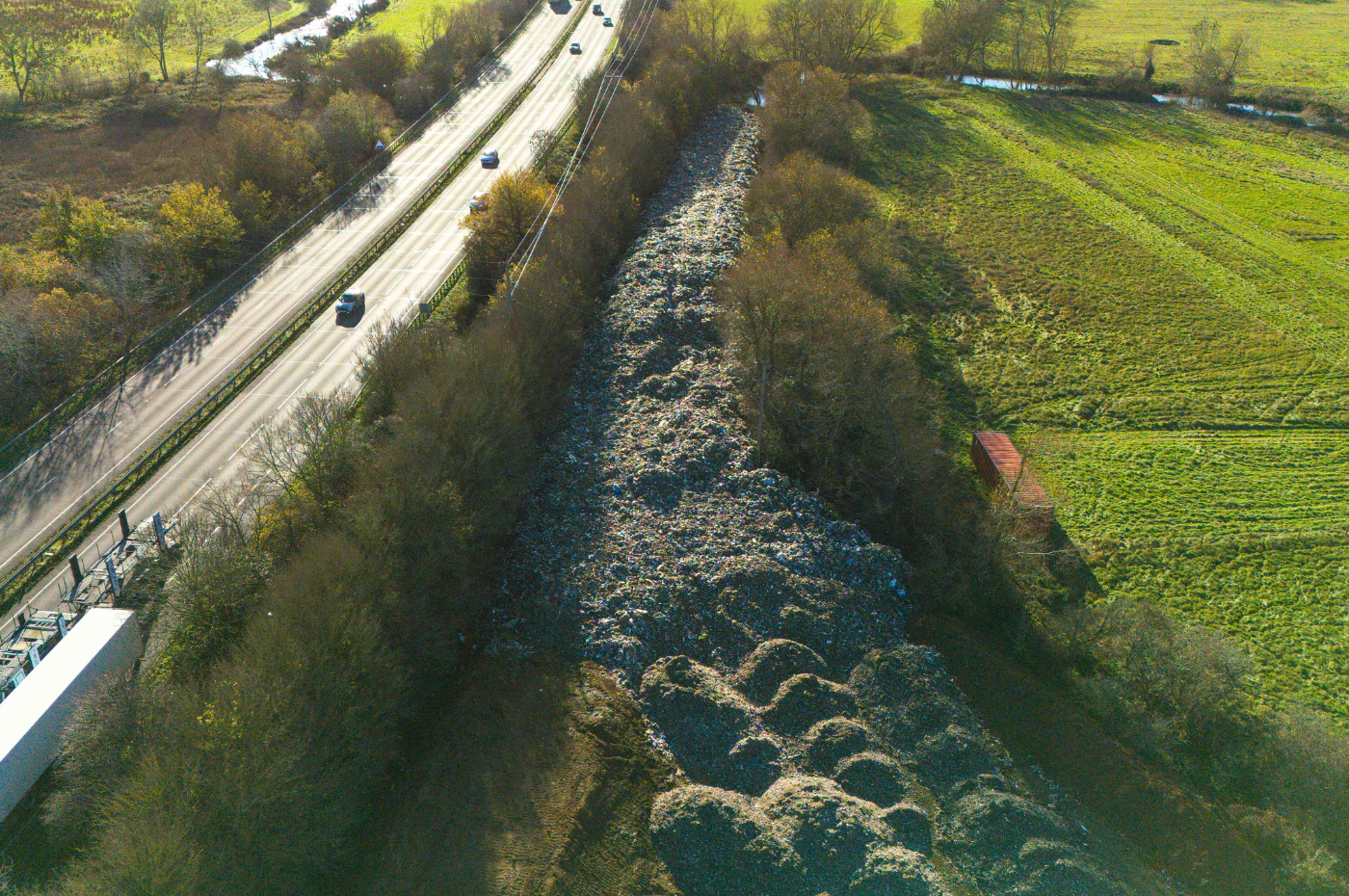
The Environment Agency has announced a major package of new enforcement measures to combat illegal waste dumping, including expanded drone surveillance, laser mapping technology and a strengthened Joint Unit for Waste Crime.
The announcement, made on 20 February 2026, includes an upgraded 33-strong drone squad equipped with LiDAR technology capable of creating highly detailed maps of illegal waste sites for use as court evidence. A new software screening tool will also cross-check lorry licence applications against waste permit records, allowing officers to identify suspect operators before they begin moving waste. The Joint Unit for Waste Crime has been expanded from 13 to 20 specialists, including former police officers, working alongside the National Crime Agency and police forces to dismantle organised criminal networks. The government has increased the Environment Agency's enforcement budget by over 50% to £15.6 million to fund the package. This builds on what the Agency describes as a record year for enforcement, during which 751 illegal waste sites were shut down and 221 prosecutions were brought against waste criminals.
The Countryside Alliance has long called for waste crime to be treated as the serious, organised criminal activity it is. Rural communities bear a disproportionate share of the damage, farmers and landowners face polluted land, threats to livestock and clean-up bills that can exceed £50,000, while organised gangs continue to profit from a criminal market estimated to be worth £1 billion a year.
Yet extraordinarily, the law compounds that damage further. Farmers who fall victim to fly-tipping are legally responsible for clearing waste dumped on their own land and can even face prosecution by local authorities for having controlled waste on their property if they fail to do so, this despite the fact that those same local authorities often fail to prosecute the original fly-tipping offence itself. The Countryside Alliance is calling on the government to end this unfair double jeopardy, which leaves farmers as the only victims of crime forced to shoulder the cost of clearing up offences committed against them. Responsibility for clearing illegal dumping should rest with local authorities, which might also give them a stronger incentive to tackle fly-tipping in the first place.
The true extent of the problem has been thrown into sharp relief by recent reporting. A BBC investigation in January revealed more than 500 illegal tips operating across England, including at least 11 so-called "super sites" each containing over 20,000 tonnes of waste. That finding sits alongside Environment Agency data showing that only around 27% of waste crime incidents are believed to be reported, meaning official statistics capture only a fraction of what is actually happening. The Agency's 2025 National Waste Crime Survey estimates that around 20% of all waste, some 38.2 million tonnes, is handled illegally each year, feeding a criminal market worth an estimated £1 billion annually.
Sarah Lee, Director of Policy and Campaigns at the Countryside Alliance, said:
"We welcome this investment and the government's recognition that waste crime is not a minor nuisance but a sophisticated, organised criminal enterprise. Rural communities have been on the frontline of this problem for too long and it is right that enforcement is being taken seriously. But there is a glaring injustice at the heart of the current system - farmers are the only victims of crime who can be prosecuted for failing to clear up an offence committed against them, while local authorities that refuse to prosecute the original fly-tip face no such obligation. That double jeopardy has to end. Technology alone will not be enough to tackle this scourge on the countryside. We also need stronger regulation of waste carriers, faster powers to shut down illegal sites, tougher sentencing and far better coordination between the Environment Agency, police, HMRC and local authorities. If this marks the beginning of a properly resourced, long-term strategy, it is a genuine step forward but momentum must be maintained, or the countryside will continue to pay the price."
The Countryside Alliance will continue to press for waste crime to be consistently treated as the organised criminal enterprise it has become and will monitor whether today's announcement translates into sustained action on the ground.
If you want to take action on the ground too, join us for the 2026 Countryside Clean-up - a community-led effort to give our landscapes a fresh start this spring. Find out how you can take part and make a difference here: Time to get your hands dirty: give the countryside a fresh start this spring

 20 February, 2026