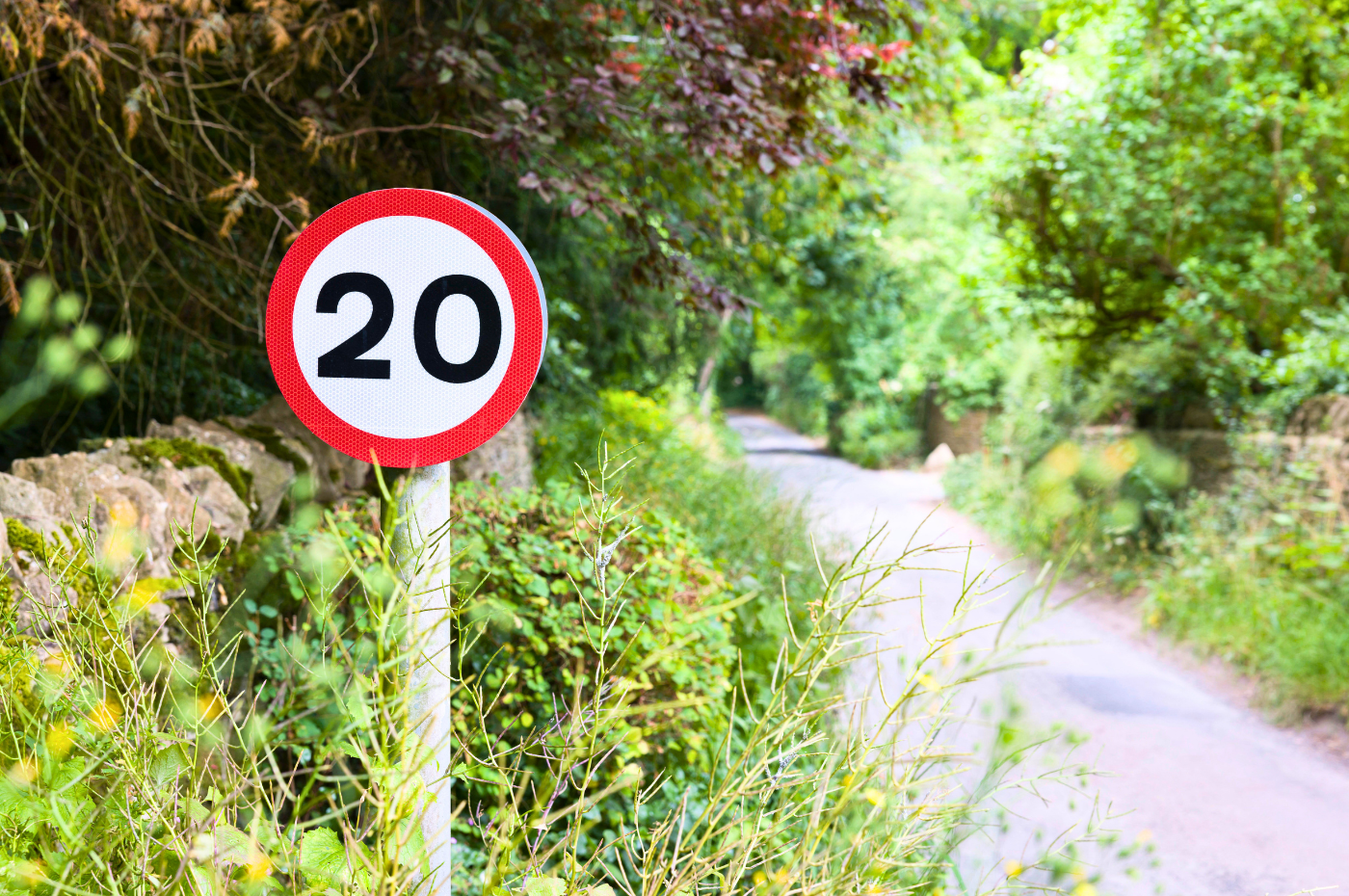
If you want to know why government is failing the countryside, then proposals for a 20 mph limit on country lanes in new guidance from a Department for Transport agency responsible for promoting walking and cycling provides a classic example.
The ‘Active Travel England’ guidelines for councils are not legally binding, but the 253-page document is intended to represent “best practice” when councils are considering roads and infrastructure in their area. It says that where people “walking, wheeling and cycling share space on country lanes with motor traffic, traffic speed should be no more than around 20mph” and informs councils that they can change speed limits by order.
Yes, you read that correctly. The government is advising that on country lanes where people walk and ride bicycles the speed limit should be “no more than 20 mph”. Given that every country lane will have someone walking or riding a bike (or horse) along it at some time or another the guidance is essentially recommending a 20 mph limit on all country lanes. Clearly whoever wrote this document and whichever Minister signed it off have absolutely no understanding of rural life. Nor can there have been any attempt to ‘rural proof’ the guidance because even the most superficial scrutiny of a proposal for a blanket 20 mph limit on rural lanes would have revealed the huge impact that would have on rural communities.
The guidance is run through with assumptions and ignorance and has a complete lack of any consideration of the interests of rural communities. It is written by advocates of cycling and walking almost entirely from the perspective of those who participate in those activities. As an example, the very lengthy guidance document contains five mentions of tractors, two references of agriculture, none of farming, five of farmers, 324 of cycle or cycles and 186 of cycling.
It is perfectly reasonable for advocates of cycling and walking to promote policies that encourage such activities and there will, of course, always be local variation, with consideration for safety paramount. Equally it is legitimate for government departments to promote activities like cycling and walking that benefit public health. What is completely unacceptable, however, is that such policies are developed with no consideration whatsoever of the impact they would have on those who live in communities that would be affected by them.
Despite decades of platitudes about rural advocacy and proofing, and despite the existence of a government department which purports to be responsible for ‘rural affairs’, successive governments have allowed - and sometimes encouraged - the partial impact of their policies on rural communities to be ignored. For added irony, the dreadful Animal Sentience Act passed by the last government created a statutory committee which could call on Ministers to show they had considered the impact of policies like this on sentient animals, but there is no committee that has any powers to protect the interests of rural people.
The countryside is at a crossroads in its relationship with the government and politics more widely. The Alliance has been warning of the widening disconnect for years and has proposed solutions to re-connect government with the countryside. There will be a new Prime Minister and very likely a new Secretary of State for Environment, Food and Rural Affairs next week. They will have an opportunity to reset the relationship between the government and the countryside, but, given the experience of the last 25 years, I would not hold your breath.

 16 July, 2026