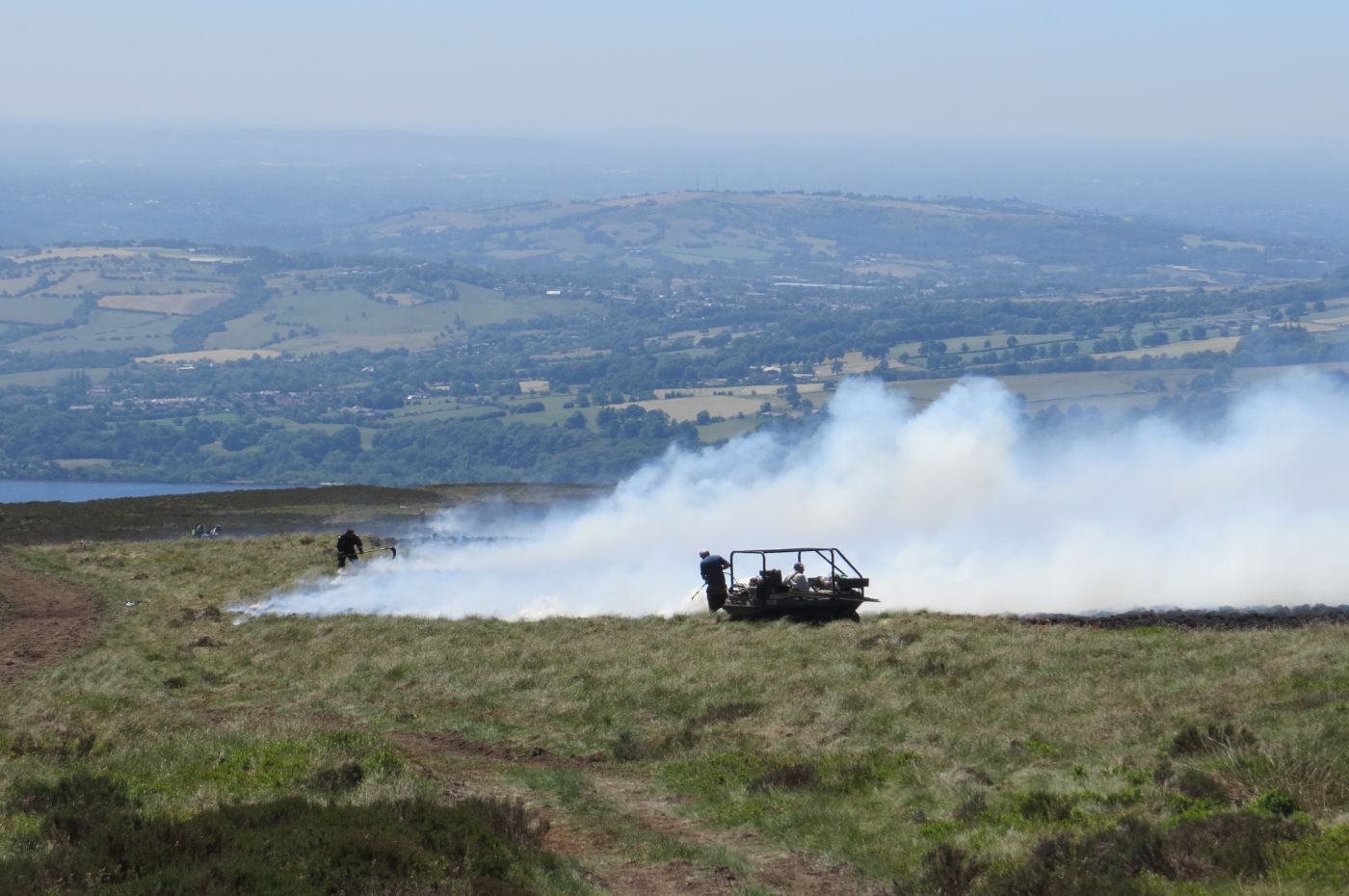
The government’s extension to the ban on burning of heather and grasslands on deep peat in our uplands from 220,000 hectares to 672,628 hectares by redefining its depth from 40cm to 30cm came into force on 30 September. This policy change follows the Consultation on Heather and Grass Burning in England undertaken earlier in the year, with Defra claiming that rewetting will be sufficiently effective in reducing heather cover and fuel loads to a level where wildfire will be far less of an issue. The Department also claims that 30cm is an evidence-based threshold for blanket bog vegetation backed by robust science following the latest evidence assessments by Natural England.
The Countryside Alliance believes this change in policy is both dangerous and irresponsible. The Future Landscapes Forum, a group of leading academics with enormous expertise and scientific knowledge currently researching this issue, has now published a position statement which is also extremely critical of the government’s policy change, and the grounds on which it has been made.
There is widespread recognition that as most scientific focus to date has been on the impacts of prescribed burning, there are significant knowledge gaps regarding the impacts of the alternative heather management tools available to moorland managers. It is only too apparent from recent data analysis and interpretation undertaken by the Future Landscapes Forum that the findings from earlier short-term studies into proscribed burning were misleading.
The Forum has also found that some key reports by Natural England and other influential organisations frequently misinterpret study findings, make misleading and even false statements and lack robust evidence to support generic claims around impacts from burning, rewetting, and alternative cutting. These concerns have been raised directly with Natural England. It is likewise concerned that the RSPB, an organisation strongly opposed to heather burning, frequently contributes to many of these reports whilst organisations and researchers with alternative views are frequently excluded.
The potentially immense and increasingly well documented risks associated with alternative management techniques such as cutting, or no management at all, are becoming increasingly apparent. These include damage to the peat surface and its microtopography, loss of habitat diversity and consequently biodiversity and an increased fuel load that can be expected to result in devastating wildfires, the numbers of which are increasing. Of particular concern is the fact that those aspects of the policy change likely to incur the greatest costs for people, place, and nature appear not to have been considered at all.
The Future Landscapes Forum believes there is currently no robust evidence to justify the recent changes to policy on heather management on peatlands, regardless of peat depth. The potential limited effectiveness of heather cutting in reducing fuel load should first be investigated along with the association between a cessation of heather management and wildfire risk, the ecological and health risks from brash accumulation, the long-term consequences of heather cutting on peat microtopography and nutrient cycling, and the effectiveness of rewetting for wildfire prevention and mitigation.
Highlighting key aspects in the overall evidence, the Future Landscapes Forum found no published scientific evidence supporting the claim that 30 cm is superior to 40 cm when defining blanket bog, the only modelling study undertaken supporting the previous 40cm depth. The impacts of burning have not been reviewed adequately or measured over sufficiently long-time scales and neither have those of cutting to justify claims that it is a superior management tool for blanket bog plant communities, the protection of peat carbon stocks, or the promotion of future peat formation. Whilst rewetting may at times be beneficial, the Forum has also found no robust science to support the claim that it can significantly reduce heather dominance on UK moorlands, particularly given the weak and sometimes contradictory evidence that prescribed burning promotes heather dominance. There is likewise no evidence that rewetting can be achieved to a meaningful extent over large areas of all moorlands.
The Future Landscapes Forum is concerned with the process used to justify the decision to effectively ban nearly all prescribed burning. The Natural England updated evidence review on burning was neither transparent nor methodologically sound and there would appear to have been no comprehensive assessment of the implications of a cutting or no management scenario. The Future Landscapes Forum has repeatedly shown that emotive and unevidenced opinions have often dominated the debate, the consultation process, many of the supporting evidence reviews, and in doing so they have overshadowed key evidence and expert experience. There is therefore the need for a full, in-depth, independent and unbiased expert review assessing the evidence underpinning the changes to policy, including the quality of Natural England’s reports and reviews. Until that has been carried out, it is believed there should be no change to policy. You can read the Future Landscape Forum’s Policy Statement here.

 07 October, 2025



.png)