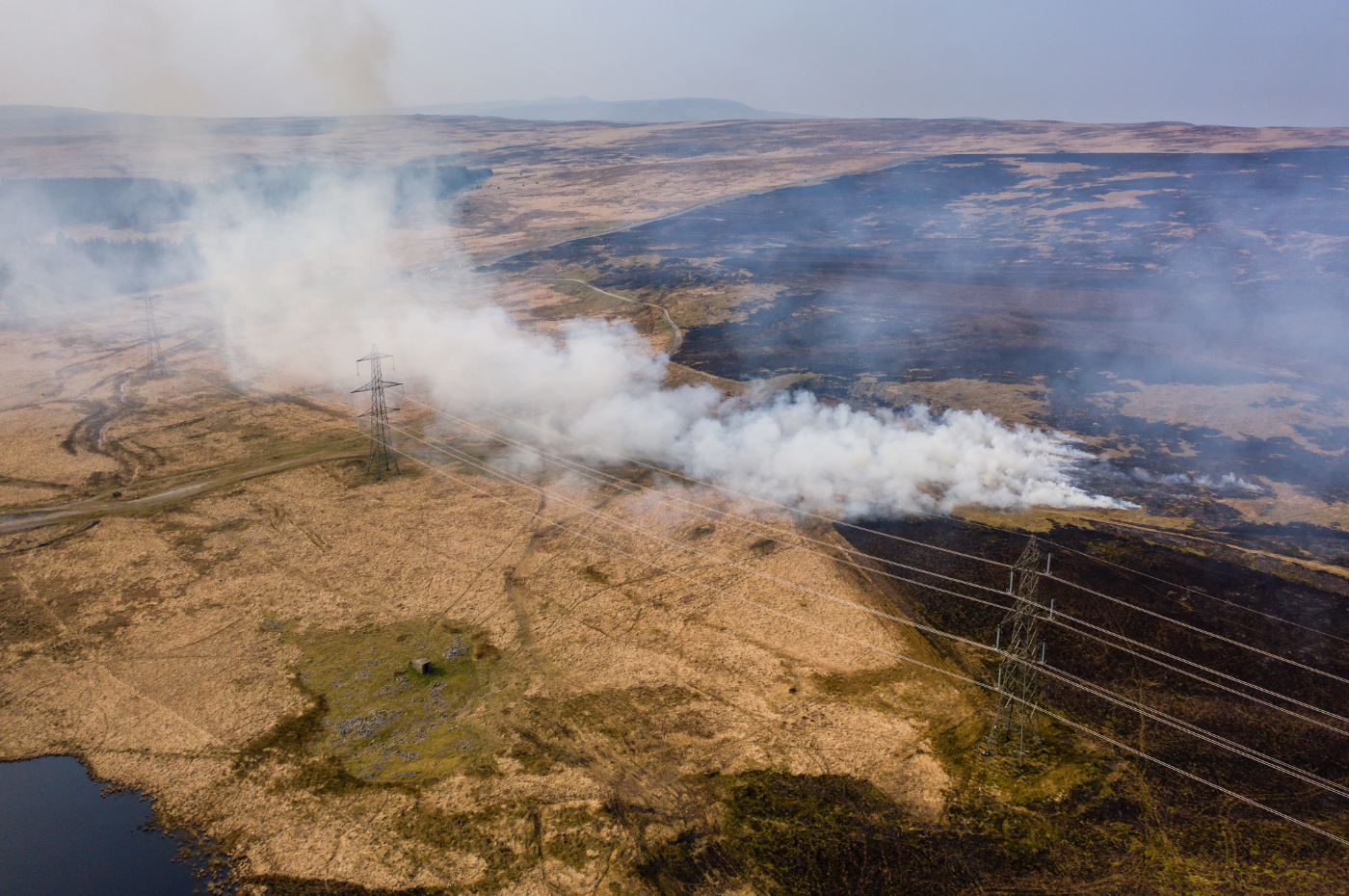
As parts of the United Kingdom head into their fourth heatwave of the year emergency services and moorland managers are bracing themselves for yet more wildfires. At the height of the third heatwave in mid-July 19 significant wildfires were being fought simultaneously in England and Wales, and in the Cairngorms a wildfire which broke out on 15 July, covering over six square kilometres at its height with over 500 firefighters tackling it, is still burning.
Last year was the United Kingdom's worst year for wildfires on record, with more than 46,000 hectares of ground burnt across the UK and at a cost of £460 million. Yet despite this the government went ahead with its extension to the ban on burning of heather and grasslands on deep peat in our uplands. This change in policy, which came into effect on 1 October, redefined the depth of deep peat from 40cm to 30cm which trebled the area over which controlled burning was effectively banned from 220,000 hectares to 672,628 hectares.
In making this change in policy the government ignored the rigorous science and evidence available, with the most recent research not even being considered. Equally worrying was the lack of understanding and knowledge of moorland areas, Defra claiming that rewetting would be sufficiently effective in reducing heather cover and fuel loads to a level where wildfires would be far less of an issue. However, whilst rewetting is important it does not prevent the surface fuel load from burning as it will still dry with the weather and ignite over saturated peat. This was seen when 22 square miles of Scotland’s Flow Country, a UNESCO world heritage site that is widely considered the most outstanding example of a blanket bog ecosystem in the world, was damaged by a wildfire which burnt for six days as a result of the vegetation becoming overgrown.
It is only controlled burning and cutting that can remove the surface fuel load, not rewetting, a fact about which the government remains in denial. On 13 July Ministers gave their annual climate and nature statement to the Commons with Mary Creagh, then Parliamentary Under-Secretary of State at Defra, rejecting the evidence and maintaining wetter peatlands are more resilient to wildfire.
Although Defra also claimed that the redefinition of deep peat from 40cm to 30cm was an evidence-based threshold for blanket bog vegetation and one that was backed by robust science following the latest assessments by Natural England, the Future Landscapes Forum, a group of leading academics with enormous expertise and scientific knowledge currently researching the burning of vegetation on moorlands, has found no published scientific evidence to support this claim. The only modelling study that has been undertaken supported the previous 40cm depth.
There is therefore no strong evidence to support this change to policy on burning on peatlands, regardless of peat depth. The Future Landscapes Forum also criticised the grounds on which the government’s policy change had been made, having found that some of the key reports produced by Natural England misinterpreted study findings, made misleading and even false statements and lacked robust evidence to support generic claims around the impacts from burning, rewetting, and alternatively cutting. And despite claims that its evidence review on the effects of managed burning on upland peatland biodiversity, carbon and water had been the subject of “rigorous peer review”, Natural England has refused to identify the retained audit trail needed to substantiate that claim, despite requests to do so.
This change in policy on burning has been widely criticised and given the seriousness of the issue we called at the time that an independent and unbiased expert review needed to be undertaken to assess all the evidence, including the quality of Natural England’s reports and reviews. With the risk of wildfires increasing, concerns are growing across Parliament and from fire services about the impact on communities and infrastructure, as witnessed only last week with the evacuation Nethy Bridge in the face of the Cairngorms wildfire.
We therefore welcomed the news that the Environment, Food and Rural Affairs Committee has commissioned research to gather the scientific evidence on which land management techniques are effective in preventing wildfire and under what circumstances and they have been asked to test Natural England’s “rigorous peer review” claim for their burning evidence.
We have likewise welcomed the establishment of an All-Party Parliamentary Group on Wildfires which brings together MPs, peers and experts to scrutinise current government policy on these issues including peatland management, national wildfire resilience and climate change, with the aim of improving understanding of the issue and to support practical, evidence-based and coordinated action.

 27 July, 2026



.png)